
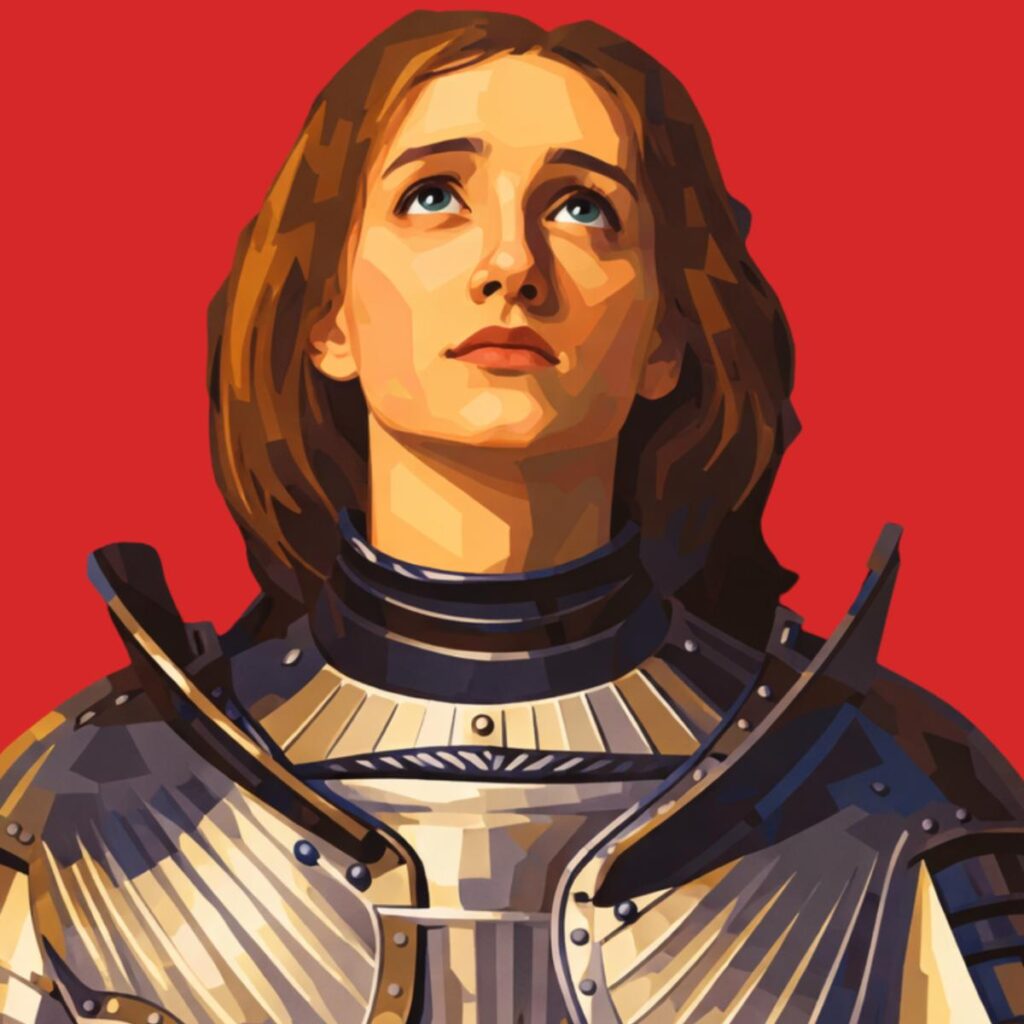
Did you know that some heroines are not born in palaces, but in the quiet countryside, where no one is really looking?
- I am only a girl…
Joan was born around the year 1412 in a small village called Domrémy. It was a land of borders, forests, and rivers - a land often haunted by fear. War had been raging for years: France and England were fighting over the kingdom, and the countryside suffered deeply.
Joan was the daughter of peasants. Her father, Jacques, worked the land. Her mother, Isabelle, taught her to pray, sew, and tend the flocks. Joan could neither read nor write, but she understood the rhythm of the seasons, the sound of church bells, and the value of hard work.
She was a serious, devout, and unusual child. While other children played, Joan would sometimes stop suddenly, as if listening to something no one else could hear.
One day, while still a teenager, Joan heard a voice. It told her it came from God.
- Who are you? Joan asked, frightened.
The voice replied:
- I come from God, and I have been sent to help you.
The voice asked Joan to do something impossible: save France.
Joan was terrified. She cried and tried to ignore the call. But the voice returned. Then came others. This time, the voices belonged to saints. They ordered her to leave her village, meet the Dauphin Charles, and lead him to his coronation.
- I am only a girl, Joan said. How could I do such a thing? I can neither read nor write!
But the voices answered:
- Go. God will help you.
At a time when women had no place in war, Joan rose and left Domrémy.
Before reaching the Dauphin, she first had to convince a man of power. She traveled to Vaucouleurs to meet Robert de Baudricourt, captain of the town and representative of the Dauphin in the region.
- I have come to speak to the king, Joan said firmly.
Baudricourt laughed at her.
- Go back home, young girl, he told her. War is no business for girls. You are mad!
Joan left, but she returned again and again, always with the same words and the same certainty, determined to fulfill the mission entrusted to her.
- I tell you, I have been sent by God! I must speak to the Dauphin! Joan insisted, her eyes shining.
Little by little, Baudricourt began to doubt his own certainty. The determination of the young girl unsettled him.
Finally, he agreed to help her. He gave her a small escort and allowed her to leave for Chinon.
For this long journey across dangerous lands, Joan had to make a difficult choice. She cut her hair and dressed like a man. It was neither a disguise nor a provocation, but protection. In this way, she could travel among soldiers, sleep without fear, and move forward without being stopped.
After days on the road, Joan arrived at the castle of Chinon, where the Dauphin Charles resided.
She was admitted to court, but the court was suspicious. How could anyone believe this young peasant girl?
To test her, they placed her before an assembly, while the Dauphin Charles hid among the courtiers. Joan had never met him before and was expected to identify him.
She entered the hall and, without hesitation, walked directly toward Charles.
- Gentle Dauphin, I have come to lead you to Reims and see you crowned king.
Silence fell over the room. The court held its breath.
After this trial, Joan was brought privately before Charles. Away from prying eyes, she spoke to him of things only he could know.
- How do you know this? Charles asked, astonished. Only God and I knew that secret.
Joan was given armor, a horse, and a white banner.
She did not fight like other soldiers. She carried a sword, but it was through her presence that she led men - riding at the front, calling for courage and confidence.
- Forward, my friends! For France! For God! Joan shouted, her voice echoing across the battlefield.
At Orléans, a city besieged for months, Joan arrived like a flame. Where fear and waiting had ruled, she brought action.
- Do not be afraid! God is with us! she cried to the people of Orléans.
Wounded by an arrow, she rose again. The soldiers, astonished, followed her.
And Orléans was liberated.
Joan then led the Dauphin to Reims. In July 1429, Charles was crowned King of France. Joan stood beside him silently, holding her banner.
- I have accomplished what God asked of me, she thought.
But the war continued.
Little by little, Joan lost the support of the court. Captured by the Burgundians, she was sold to the English.
Then began the dark days.
Imprisoned, chained, constantly watched, Joan was put on trial. She was accused of heresy, lying, and witchcraft. The judges were learned men, and the questions were cruel.
- Your voices lie, they told her. You are a witch!
Alone, Joan answered with simplicity and courage.
- If I am not in God’s grace, may God place me there. And if I am, may God keep me there. I have only followed the voices God sent me.
At nineteen years old, she was condemned.
On May 30, 1431, in Rouen, Joan climbed the stake. The crowd watched. Some wept. Others remained silent.
As the fire was lit, Joan cried out the name of Jesus.
- Jesus! Jesus! Jesus!
The flames rose.
Her body disappeared.
But not her story.
Years later, a new trial declared Joan innocent. She became a symbol - of courage, faith, and freedom.
Joan of Arc was neither a queen nor a scholar. She was a child of the people who dared to believe in a mission greater than herself. Her story reminds us that even a fragile voice can change the course of history. And somewhere, even today, whenever injustice seems too powerful, Joan’s name continues to burn like a flame that never goes out.