
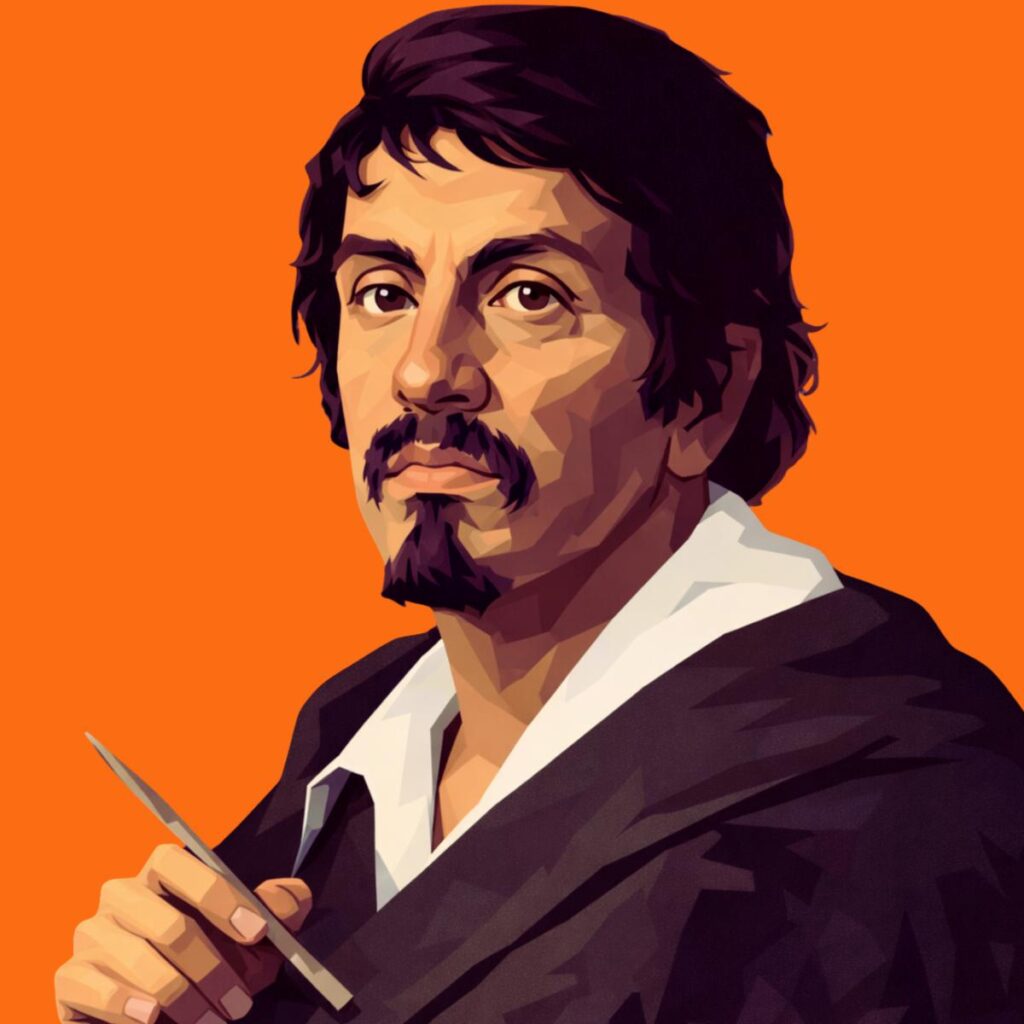
It is said that sometimes genius is born in the most unexpected places. In Caravaggio’s case, we are talking about a harsh world full of contrasts: dark taverns and streets marked by poverty and danger. There, in that Rome hidden in shadow, the young artist found not only models, but also the truth he would later transform into art.
Born Michelangelo Merisi, Caravaggio came into the world in Milan in 1571. His name was not chosen by chance—it is believed to be linked to his birth date, September 29, dedicated to Saint Michael the Archangel. The nickname “Caravaggio” was later given to distinguish him from the famous Michelangelo Buonarroti.
His childhood was far from easy. At just six years old, his family moved to the town of Caravaggio to escape the bubonic plague that was devastating the region. The disease claimed many lives, including members of his family, and at the age of eight he lost his father—a loss that deeply marked him.
And yet, from these shadows, a light began to emerge: his passion for drawing. Young Michelangelo sketched with charcoal, capturing faces and shapes with unusual sensitivity. At 13, he entered the workshop of Simone Peterzano, where he learned anatomy, perspective, and oil techniques. After his apprenticeship, he traveled across Florence and Venice to study the great masters.
By 1596, Caravaggio was in Rome, working in difficult conditions. His talent soon caught the eye of Cardinal Francesco Maria Del Monte, who offered him a room and an allowance—a turning point that transformed him from a poor painter into a protected rising star.
A few years later, he received a major commission for a series dedicated to Saint Matthew. This marked his true artistic recognition. He revolutionized painting through a technique that would define the era.
Chiaroscuro: the dramatic contrast between light and shadow. To Caravaggio, light was not just decorative; it was a character that revealed raw emotion and the hidden truth.
However, masterpieces like The Death of the Virgin caused scandal because he used real models from the lower classes. But this was Caravaggio’s essence: reality over ideal beauty. He painted beggars and tired faces as saints, proving that the divine exists in the everyday struggle.
His life was as intense as his art. Violent and impulsive, he was often involved in conflicts. In 1606, he killed a man during a fight and was sentenced to death, forcing him to flee Rome. He wandered through Naples, Malta, and Sicily, creating masterpieces even while in exile, such as The Beheading of Saint John the Baptist.
In 1610, hoping for a papal pardon, he set out for Rome—but never arrived. He died at 39 under mysterious circumstances. Ironically, his pardon was granted shortly after his death, just as his influence began to spread across Europe.
Caravaggio changed how we see reality: he taught us that beauty lies in imperfection and that light exists only alongside shadow.