
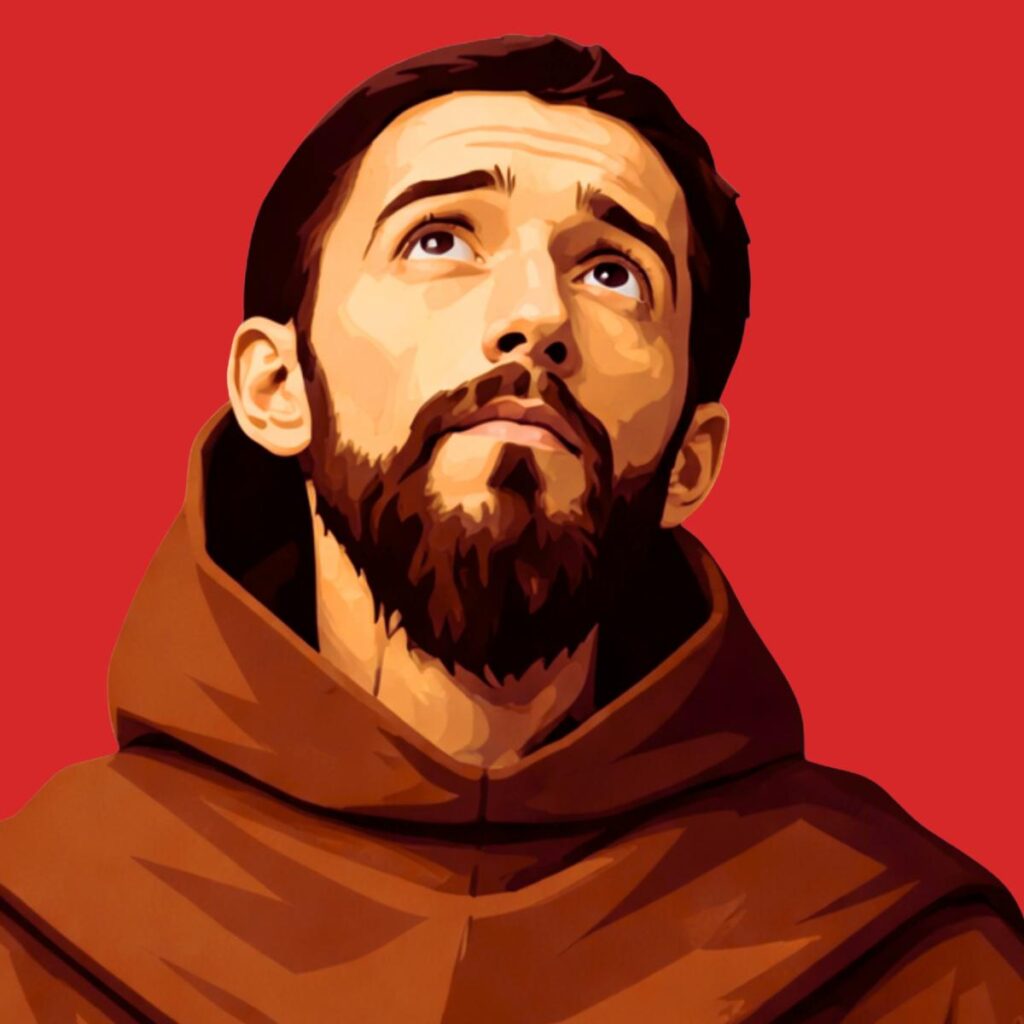
“Sweet Is the Feeling” – Francis of Assisi, The Knight Who Chose the Sun and Peace. Imagine a young knight dressed in silk, with a sword at his side and a heart full of dreams of glory. It sounds like the beginning of an adventure movie, doesn’t it? But it is not quite so. The story of Francis of Assisi is not about battles won with weapons, but about a silent revolution that changed the world forever.
Francis of Assisi did not search for magical recipes. Instead, he discovered the secret of true joy: feeling like a brother to every creature and having an ideal of peace worth fighting for.
Francis was born in Assisi between 1181 and 1182, in a house that smelled of fine fabrics. His father, Pietro di Bernardone, was a wealthy merchant who made his fortune trading with France. When he returned from one of his journeys, he decided to name his son “Francesco,” meaning “the Frenchman,” as a tribute to the land that brought prosperity to their family.
As a boy, Francis was the life of the city. He played sweet music, danced, and charmed everyone with his talent as a merchant. But in his heart there was another dream: he wanted to become a noble knight.
The peaceful life of Assisi was suddenly shaken by war. Francis was captured and imprisoned in Perugia. There, in the cold and sickness of the prison, the world of silk and comfort he had always known began to fade. Between the walls of that prison, Francis’s life changed. In silence and suffering, he began to understand that wealth could not give true peace. When he finally returned home, something in his heart had changed forever.
One winter day, as he was walking through the countryside of Assisi wrapped in his fine clothes, he met an elderly poor man who was sick and trembling from the cold. Snow was falling heavily, but Francis did not walk past him. He stopped, looked into the man’s eyes, and felt his pain as if it were his own. Without saying a word, he removed his heavy wool cloak and wrapped it around the old man’s shoulders. In that moment, he understood that giving brings a warmth that no expensive fabric could ever equal.
The moment of his final decision came in the little church of San Damiano, where he heard a voice asking him to repair God’s house. Francis, with his usual determination, sold his father’s fabrics to buy stones and bricks. His father, believing he had gone mad, dragged him before the bishop.
In the main square of Assisi, before the bishop and the whole city, Francis made his boldest gesture: he removed his elegant clothes, gave them back to his father, and said firmly:
— Until now I have called you my father on earth; from now on I can say with certainty: ‘Our Father who art in heaven,’ because in Him I have placed all my treasure.
It was the year 1207, and soon others began to follow him, attracted by the sincerity of his life. Bernardo da Quintavalle, a wealthy magistrate, was deeply moved when he saw Francis praying throughout the night. Together they decided to sell everything they owned and live by helping others.
From that day on, Francis’s “Rule” was simple and clear. To the companions who wanted to follow him he said:
— Our life is to observe the Gospel: we will live in obedience, humility, and without possessing anything of our own.
While the world was shaken by the Crusades, Francis decided to do something unimaginable. In 1219 he traveled to Egypt and, unarmed, crossed the enemy lines to meet Sultan Malik al-Kamil. The guards wanted to stop him, but they were struck by his gentleness. Standing before the powerful Sultan, Francis did not speak of war but of brotherhood:
— Peace be with you, great Sultan. I do not come as an enemy, but as a brother who wishes to speak of the peace that only God can give.
The Sultan, moved by his courage, welcomed him with respect. He did not convert, but he allowed Francis to return safely. It became one of the earliest and most powerful examples of dialogue between cultures—proof that words can be stronger than swords.
Even Pope Francis recalled this meeting during his visit to the United Arab Emirates in 2019, presenting it as an inspiration for human fraternity and interreligious dialogue. If today one of the traditions of Christmas is the Nativity scene, we owe it to Francis of Assisi.
It was the year 1223, and Francis was staying in retreat near the small village of Greccio, in the mountains near Rieti. With some Franciscan brothers, he sought silence and meditation, living almost like hermits. Francis was already ill and nearly blind. His companions pleaded with him: "Francis, we must find a better place for you!"
He finally agreed to come down from the mountain and chose a bare cave as his dwelling. He was living through a troubled time after a long preaching journey in the East—through Egypt, Syria, and the Holy Land. In Bethlehem he had visited the cave where Jesus is believed to have been born, and the experience deeply moved him.
So he told the brothers:
— I would like to represent the Child born in Bethlehem. Prepare everything as I have asked, and we will spend Christmas night there.
And so the first living Nativity scene was created: a manger placed between an ox and a donkey inside a cave. The goal was to bring the mystery of Christmas outside the churches and make it accessible to the people. If you ever travel to that region, you can still visit the hermitage carved into the rock where Francis staged the first Nativity.
Now imagine the city walls of Gubbio eight hundred years ago. The sun has set, the streets are empty, and the only sound is the bolts of doors being locked. The city is trapped in fear. Outside, in the dark forest, a terrible creature roams: a huge, ferocious wolf that spares no one.
But in the middle of this atmosphere of war, a thin figure walks out of the city gates. It is Francis. He walks alone—without sword, without shield. At the edge of the forest the wolf suddenly leaps out, its teeth bared. Francis slowly raises his hand and says gently:
— Come here, Brother Wolf. In the name of God, I command you not to harm me or anyone else.
The beast lunges forward, but Francis does not run away. Something incredible happens. The monster that had terrified all of Umbria suddenly stops. It lowers its head, closes its jaws, and lies down at Francis’s feet like a scolded dog. Francis speaks to him as one would speak to a friend who has made a mistake: "Brother Wolf, you have done great harm in these lands... but I know why you do it: you are hungry, aren’t you?"
Before the astonished citizens watching from the city walls, Francis makes a pact: "I will make sure that the people feed you every day, and in return you will never again attack any human or animal. Do we have an agreement?" The wolf lifts his paw and gently places it in Francis’s hand.
That day Gubbio did not win a war—but it learned a lesson: that the “monster” is often simply someone who suffers, and that the only way to defeat an enemy is to turn him into a brother.
Francis did not want the beauty of the world to be a secret known only by scholars. That is why he wrote the Canticle of the Creatures, considered the first great “lay prayer” in history. He did not use Latin but the Umbrian vernacular—the simple language spoken by ordinary people in the streets. Because of this revolutionary choice, even the humblest person could understand its meaning and give thanks for Brother Sun and Sister Moon.
Written around 1224, this hymn is considered the oldest poetic text of Italian literature and a jewel of world literature. Its spirit lives on in the famous song “Dolce è sentire.” The melody has been performed by great opera legends such as Andrea Bocelli and Luciano Pavarotti, bringing Francis’s message to every corner of the world.
Francis died in Assisi on October 3, 1226, but his feast is celebrated on October 4. Today Francis of Assisi is the Patron Saint of Italy. In 1979 Pope John Paul II officially proclaimed him the patron saint of ecology, because he taught us that respecting nature and one another is the only way to be truly happy.
His life offers a vision—long before our time—of caring for the environment and protecting natural resources, such as water, which he called “Sister Water,” precious and pure.
Start by doing what is necessary, then what is possible. Suddenly you will find yourselves doing the impossible.