
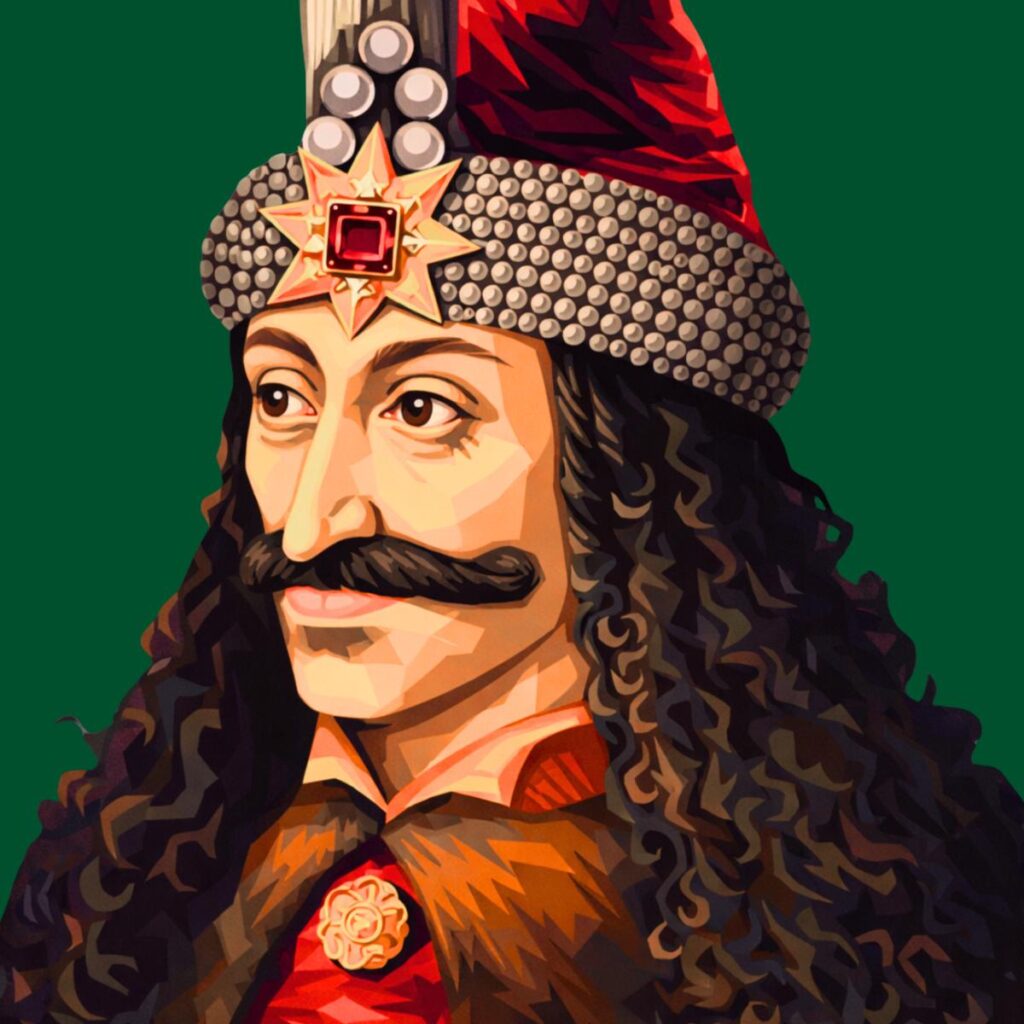
Did you know that even true stories begin with… once upon a time? There is a ruler about whom so much has been said that no one is quite sure anymore where truth ends and legend begins. His name is Vlad Țepeș. The writer Bram Stoker turned him into a mythical character. But who was Vlad Țepeș really: a hero or a legend?
His story begins in the year 1431, in the fortress of Sighișoara, in Transylvania. His father, Vlad Dracul, was the ruler of Wallachia. He was a member of the Order of the Dragon, an order of knights that fought to defend Christianity against the Ottoman Empire. The symbol of the order was a dragon, which Vlad Dracul used on flags, coins, and seals. Because in Latin dragon was called draco, people began to call him “Dracul.” Thus, Vlad Țepeș became known as Dracula Voivode, meaning “the son of the dragon.”
In a troubled time, full of battles and fragile alliances, the child’s life changed suddenly. In order to keep his throne, his father was forced to make a painful sacrifice. Thus, at only 11 years old, Vlad and his younger brother, Radu the Handsome, were sent as hostages to the court of Sultan Murad II. Far from home, in Constantinople, the two boys grew up in a foreign world, as was customary at the time: the sultan took the children of rulers to ensure their parents’ loyalty. Vlad received a refined education. He studied the art of war, geography, mathematics, sciences, and foreign languages. Nevertheless, he dreamed of the day he would return home.
The years passed, and his father was betrayed and killed by the boyars. With Ottoman support, the young Vlad, who was then 17 years old, was sent back to his country to take the throne. His first reign lasted only one month. Vlad went into exile in Moldavia, to the court of his relatives. Eight years later, in 1456, he regained the throne. This was his second and most important reign.
Vlad was determined to be a strong ruler and to bring order to the country. He began to remove the boyars who were his enemies or who disobeyed his commands. Many considered him harsh, but he believed that only through discipline could the country prosper. He imposed very severe punishments, the most famous being impalement, from which he received the name Vlad the Impaler.
Although severe, he was respected and loved by the people. He supported trade, encouraged the building of roads and villages, strengthened fortresses and monasteries, and protected merchants and peasants, who formed the army of the country. Under his rule, Wallachia became safer and wealthier. It is said that he managed to drive away criminals, and that people could travel day and night without fear.
At first, in order to gain time, he accepted submission to the Turks, but one day he made a courageous decision: to stop paying the annual tribute of 10,000 gold coins to the sultan.
Sultan Mehmed II set out against Vlad with a huge army of over 120,000 men. Having far fewer soldiers, Vlad used harsh strategies: he burned the fields, devastated the lands, and poisoned the wells. Hungry and thirsty, the Turks advanced with increasing difficulty.
On the night of June 16–17, 1462, Vlad delivered the decisive blow: the Night Attack. With their faces covered and without making a sound, the soldiers approached the enemy tents. Swords flashed in the darkness, and the Turks, taken by surprise, were slaughtered. The sultan narrowly escaped, saved only because his tent was mistaken for another. After this unexpected strike, the Ottoman army was forced to retreat.
After the great battle with the Turks, things began to turn against Vlad. The sultan devised a cunning plan: he supported Radu the Handsome to become ruler and promised the boyars peace and a carefree life. Left without support, Vlad relied on the help of his ally, Matthias Corvinus, king of Hungary. However, instead of helping him, the king had him arrested, accusing him of treason. Vlad Țepeș was held prisoner for 12 years. Little is known about the years he spent in captivity. It seems, however, that his life was not a harsh one. He took part in royal hunts and official banquets, converted to Catholicism, and married a lady of the high Hungarian nobility.
In 1475, Vlad Țepeș returned for the third time to the throne of Wallachia. Unfortunately, his reign lasted only a short time. At the end of the following year, he was forced to fight the Turks once again. During the battle, he climbed a hill to better observe what was happening. Because he was wearing clothes similar to those of the enemy, he was not recognized and was attacked. Some say he was even killed by his own soldiers, on the orders of traitorous boyars. To prove that Vlad Țepeș had died, his head was sent to the sultan in Constantinople. Thus ended the story of one of the most feared rulers of the Romanians.
Dracula is a fictional character, a vampire count who lives in a castle on a rock, while Vlad Țepeș was a real ruler. Over time, history became intertwined with legend, and each storyteller added something more. Thus, Vlad Țepeș has remained a powerful and mysterious figure, standing at the boundary between truth and story, a ruler who continues to fascinate us even today.