
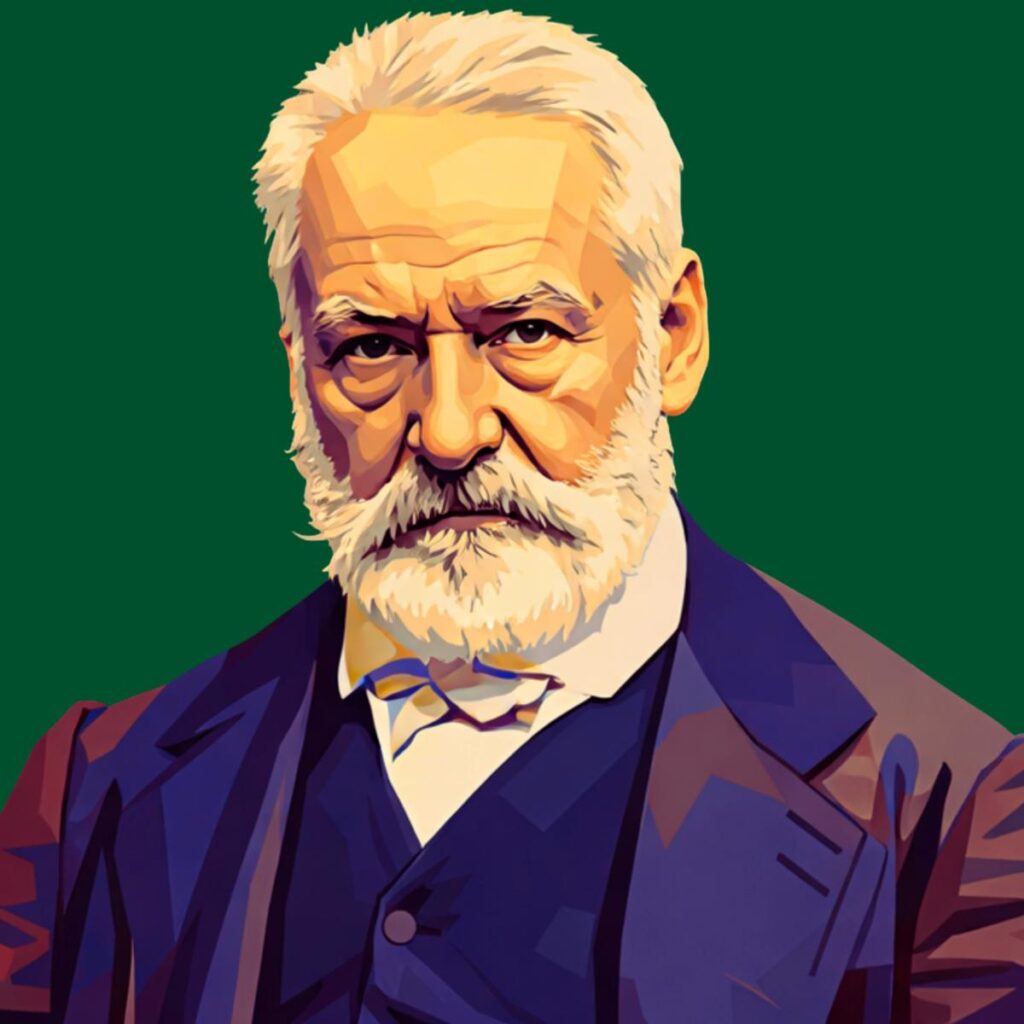
“The freedom to love is no less sacred than the freedom to think.” “This baby will not survive,” declared the midwife at Victor Hugo’s birth. But Sophie, his mother, surrounded her baby with tenderness and love, and Victor survived! He grew up in Paris, at Les Feuillantines, with his two brothers and his mother. Their father, Léopold Hugo, was a general in Napoleon I’s army.
At school, he was a brilliant student. He wrote his first real poem at the age of twelve for a friend of his parents. At fourteen, he wrote in his journal: “I want to be Chateaubriand or nothing.” Chateaubriand was the author of Atala, a hugely successful novel.
Victor possessed boundless ambition and fierce determination.
When the French Academy launched a poetry competition in 1817, Victor, only fifteen years old, quickly composed a poem that ranked ninth and earned him special recognition. He spent most of his time writing and completed his second novel at sixteen.
But his happy youth came to an end when he learned of the death of his mother, who had loved him deeply. He found love again with a childhood friend, Adèle Foucher, whom he married once his financial situation became stable enough to support a family.
Their marriage followed their first tragedy: the death of their eldest son, Léopold, at the age of four months. Then came Léopoldine, their second child. What happiness for Victor, deeply in love with his wife and his little “Didine.”
His inspiration soared. He wrote a preface that would later be considered the manifesto of Romanticism, a new literary movement championed by young writers who wanted imagination and emotion to triumph.
At twenty-five, Victor Hugo became the leader of a new generation of authors: Balzac, Vigny, Mérimée, Sainte-Beuve…
At twenty-six, Victor Hugo was already a celebrated writer. He decided to write a novel set in the Middle Ages: Notre-Dame de Paris (The Hunchback of Notre-Dame). It would remain a monument of paper and ink beside the old cathedral itself.
Upon its publication in 1831, it achieved enormous success.
Success followed success, but his personal life was beginning to crack apart… Victor discovered that his close friend Sainte-Beuve and his wife Adèle were having an affair.
“Hatred is the winter of the heart,” he wrote in Les Contemplations.
After this painful experience, he found hope again when he met Juliette Drouet, a young Breton actress performing in his play Lucrèce Borgia at the Théâtre de la Porte Saint-Martin.
“Are we born twice? Yes. The first time, on the day we are born into life; the second time, on the day we are born into love.”
That is what he wrote to her. The correspondence between Victor and Juliette is a unique monument in the history of romantic literature. He alone wrote between 20,000 and 25,000 letters to her. Their powerful love lasted fifty years. Yet Victor never considered leaving his wife.
Sadly, his heart would be broken once again after the death of his daughter Léopoldine, to whom he dedicated one of his most beautiful poems:
Tomorrow, at dawn, at the hour when the countryside whitens,
I will depart. You see, I know that you await me.
I will go through the forest, I will go across the mountains.
I can no longer remain far from you.
I will walk with my eyes fixed upon my thoughts,
Without seeing anything outside, without hearing a sound,
Alone, unknown, my back bent, my hands crossed,
Sad, and for me the day will be like the night.
I will look neither at the gold of the evening falling,
Nor at the sails descending toward Harfleur in the distance,
And when I arrive, I will place upon your grave
A bouquet of green holly and flowering heather.
Léopoldine’s death abruptly shattered the poet’s inspiration. Victor then found an outlet in political life. In his speeches, he fiercely denounced social injustice and continued to proclaim his opposition to the death penalty.
He would fight all his life for its abolition, regularly asking kings and foreign rulers for mercy so condemned prisoners could escape execution.
After the abdication of King Louis-Philippe, the Second Republic was proclaimed in 1848. Gradually, Victor distanced himself from Prince-President Louis-Napoléon and eventually became his fiercest opponent.
“What! Because we once had Napoleon the Great, must we now have Napoleon the Little?”
In 1851, Louis-Napoléon seized power through a coup d’état, and the government banished Victor Hugo from France. Sought by soldiers, he escaped by train to Belgium. A long exile began.
During his exile, he lived in Jersey and then Guernsey, where he completed Les Contemplations, a poetry collection that achieved immediate success.
Yet this life in exile became a tremendous source of inspiration for the poet. Never before had he had so much time and mental freedom to write. It was in Guernsey that Les Misérables was born.
After the defeat of Napoleon III, Victor Hugo was finally able to return. His exile had lasted nineteen years.
Very quickly, Hugo resumed his political activities. He was elected deputy and later senator. He became a passionate defender of human rights.
“You have done nothing as long as those who are in the strength of their working years can be without bread! As long as those who are old and can no longer work are without shelter!”
On May 22, 1885, the icon of French literature died at the age of eighty-three. A national mourning period was declared, and crowds paid tribute to him for an entire week.
His coffin was displayed beneath the Arc de Triomphe. His tomb lies in the Panthéon, the official resting place for France’s greatest figures.