
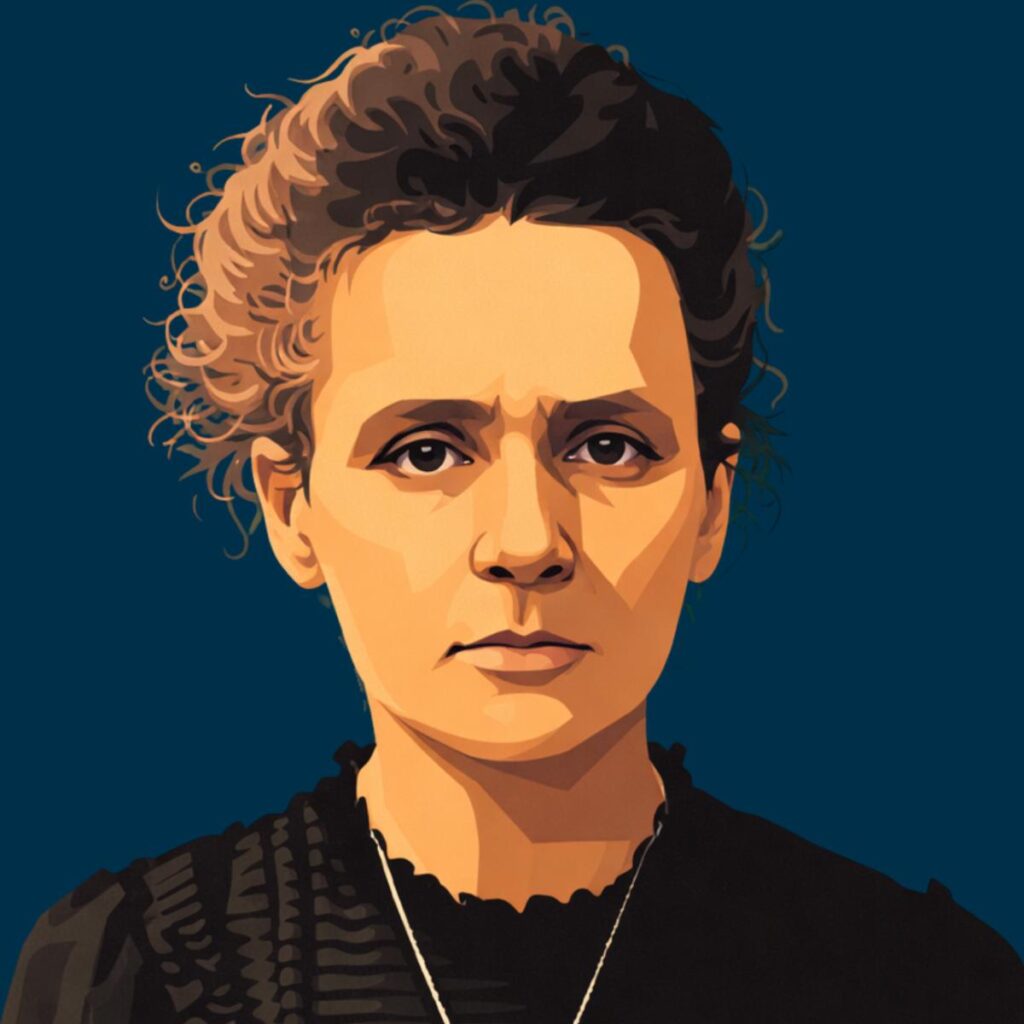
This is the story of the woman with two Nobel Prizes: Marya Skłodowska, born in Warsaw in 1867, in a Poland torn apart by Russian occupation. Her family had very little money, and Marya experienced a difficult childhood. Her sister Sofia died of typhus, and two years later, her mother passed away from tuberculosis. Marya took refuge in her studies, where she excelled.
“I want to become a doctor, to cure diseases!”
She earned the highest grades in every subject, and at sixteen, she completed her studies not only with a gold medal, but also with a passion: physics.
She wished to continue her education, but at the dawn of the twentieth century, higher education was forbidden to women in her homeland, Poland. End of the road for Marie.
At that time, for a woman who wanted to pursue higher studies, Paris was the place to be. Welcomed by her sister Bronia, Marya arrived in 1891 in the City of Light to study at the prestigious Sorbonne University, which accepted women.
From then on, Marya, now calling herself Marie, devoted all her time to her studies. Unsurprisingly, she graduated first in her physics degree.
She immediately continued with a mathematics degree, finishing second in a Sorbonne where women represented only 3% of the students.
With her diplomas in hand, she began her career as a researcher, working on the magnetic properties of different steels in a laboratory. It was there that she met Professor Pierre Curie: a meeting that changed her life.
Despite their romance, Marie did not change her plans. She left Paris and returned to her native Poland. But once there, she realized something was missing or rather, someone: Pierre Curie.
They began exchanging letters, and eventually Marie decided to return to France, where she would be in a much better environment to continue her research… and closer to Pierre to make up for lost time.
They celebrated their wedding in 1895. “A new life began for me, very different from the solitary existence of the previous years. With the money we received as wedding gifts, we bought two bicycles, on which we took rides outside the city.”
After the birth of their first daughter, Marie took on a new challenge: she wanted to earn a doctorate in science.
To do so, she needed to choose a subject for study.
“Well then, it shall be those famous uranium rays!”
To conduct her experiments, Marie set up her laboratory in an abandoned shed. For weeks, she tested all kinds of rocks to determine whether they contained uranium.
One day, while examining pitchblende, a heavy mineral, she was astonished: “It gives off incredibly powerful rays! Look, Pierre!”
Her husband, who shared the small laboratory with her, was equally intrigued. He abandoned his own work, and together they began long chemical analyses.
Eventually, Pierre and Marie discovered that pitchblende contained two unknown metals in tiny quantities. They named them polonium (in honor of Poland) and radium.
“Can you imagine?” Marie exclaimed. “This radium produces a million times more radiation than uranium, it’s phenomenal!”
She decided to name this phenomenon radioactivity.
But radium was much more than a natural source of energy. Soon, they discovered that radium could destroy healthy cells as well as diseased ones, meaning it could help treat certain cancers.
During the following years, and up until around 1940, there was a true “radium craze.” People believed it could cure countless illnesses. Sadly, at the time, no one realized that this “miracle product” was in fact extremely dangerous.
In high doses, radioactive particles attack the skin and eyes, penetrate the body, and destroy or alter cells.
Marie and Pierre suffered the consequences themselves. Four years of handling radium without any protection slowly poisoned them.
In 1903, Marie earned her well-deserved doctorate in physics, and later that same year, she and Pierre received the prestigious Nobel Prize in Physics.
Awards continued to follow, but one year later, shortly after the birth of their second daughter, Pierre died in a terrible accident.
Marie was devastated.
Nevertheless, she accepted a position as professor of physics at the Sorbonne. She became the first woman ever to teach at the university.
Over time, Marie found the strength to overcome her grief and continue their research alone.
In 1911, she received her second Nobel Prize: the Nobel Prize in Chemistry.
In 1914, one of her dearest wishes came true: the Radium Institute, which she would direct, opened its doors.
It was a major research laboratory in physical chemistry focused on treating cancer through radiation.
But then a terrible event changed everything: the First World War broke out.
War raged across Europe.
One day, Marie discovered with shock that French military hospitals near the battlefields had no radiology equipment. “Incredible!” she protested. “They have no way to perform X-rays! They operate on wounded soldiers blindly, without knowing exactly where the bullets or shell fragments are!”
The decision was made. Marie and her two daughters, now seventeen and ten years old, organized an entire network of cars and vans equipped with radiology machines, staffed by women trained in radiography.
In 1918, the Armistice was signed.
Marie was invited to many countries and welcomed with the highest honors in the United States, Belgium, Spain, Italy, the Netherlands, and Brazil.
Despite her declining health, she continued her relentless work in her laboratory at the Marie Curie Foundation.
On July 4, 1934, Marie Curie died of leukemia caused by radiation exposure.
In 1995, her remains and those of her husband were transferred to the Panthéon. She became the first woman honored there for her own achievements.
Her extraordinary life made her one of the greatest figures of modern science and an enduring symbol of dedication, perseverance, and the emancipation of women in society.