
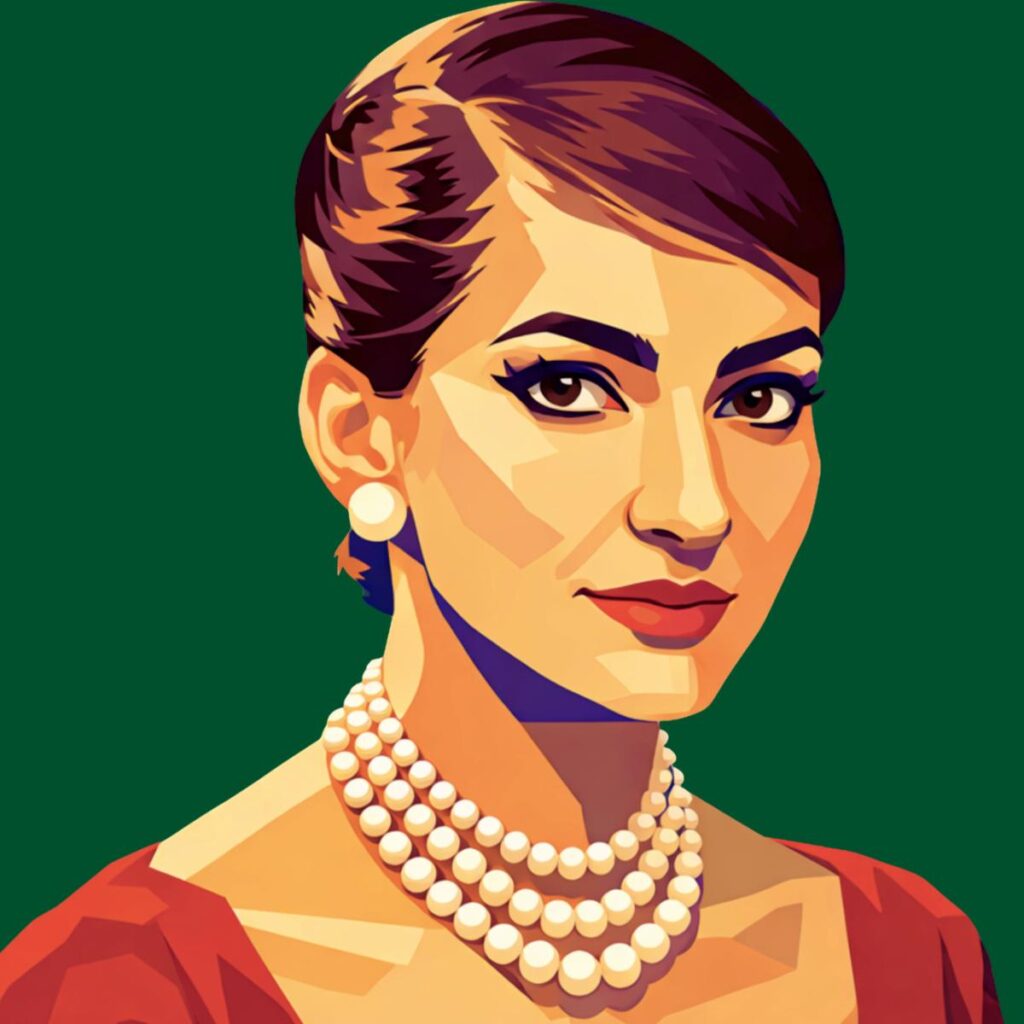
Maria Callas was born in 1923 in New York to a family of Greek immigrants. From her earliest years, her life was not easy. The family environment was filled with tension and emotional coldness, with her mother exerting strict pressure and seeing in Maria mainly the extraordinary talent that had to be developed. The child who needed love and acceptance was often left on the sidelines, which created in her a deep sense of loneliness.
During her adolescence, Maria experienced intense insecurity about her appearance. She was overweight and often received criticism, something that seriously wounded her self-esteem. At the same time, the weight of expectations was overwhelming. She constantly had to prove her worth—not only as an artist but also as a person. Her voice, which would later become legendary, was at that time both a refuge and a prison.
At a young age she returned to Greece with her mother. Instead of stability, she found herself in an Athens under occupation, full of poverty, hunger, and uncertainty. Her studies at the Athens Conservatory were exhausting, marked by strict discipline and endless hours of practice. Maria matured prematurely, without space for carefree moments or teenage dreams. Music became her only means of escape and survival.
Her international career took off in Italy, where she performed in the world’s greatest opera houses, most notably at La Scala in Milan. Maria Callas did not simply sing—she interpreted. Every role became a dramatic confession, filled with intensity and psychological depth.
— Thus was born the myth of “La Divina”.
The woman who renewed opera and made it once again a living form of theater. These experiences from her youth shaped both her character and her art; the drama that characterized her performances were reflections of her soul.
A particularly important part of her artistic legacy is her discography. Maria Callas was among the first opera singers to systematically record their work, leaving behind an invaluable archive. Her discography includes complete opera recordings, recitals, and arias, featuring iconic roles such as Norma, Tosca, La Traviata, Medea, and Lucia di Lammermoor.
— "First I lost my weight, then I lost my voice, and now I've lost Onassis."
Her personal life was equally turbulent. Her marriage to Giovanni Battista Meneghini did not provide the emotional fulfillment she was seeking. Her great love affair with Aristotle Onassis was passionate but also deeply painful, leaving wounds that never truly healed. As time passed and her voice began to decline, Maria Callas gradually withdrew from the stage.
She passed away in 1977 in Paris, alone—much as she had often felt during her life. Yet her voice never fell silent. Through her recordings, her performances, and the legend she created, Maria Callas continues to move and inspire audiences worldwide.
Her story is that of an artist who transformed pain into eternal art.