
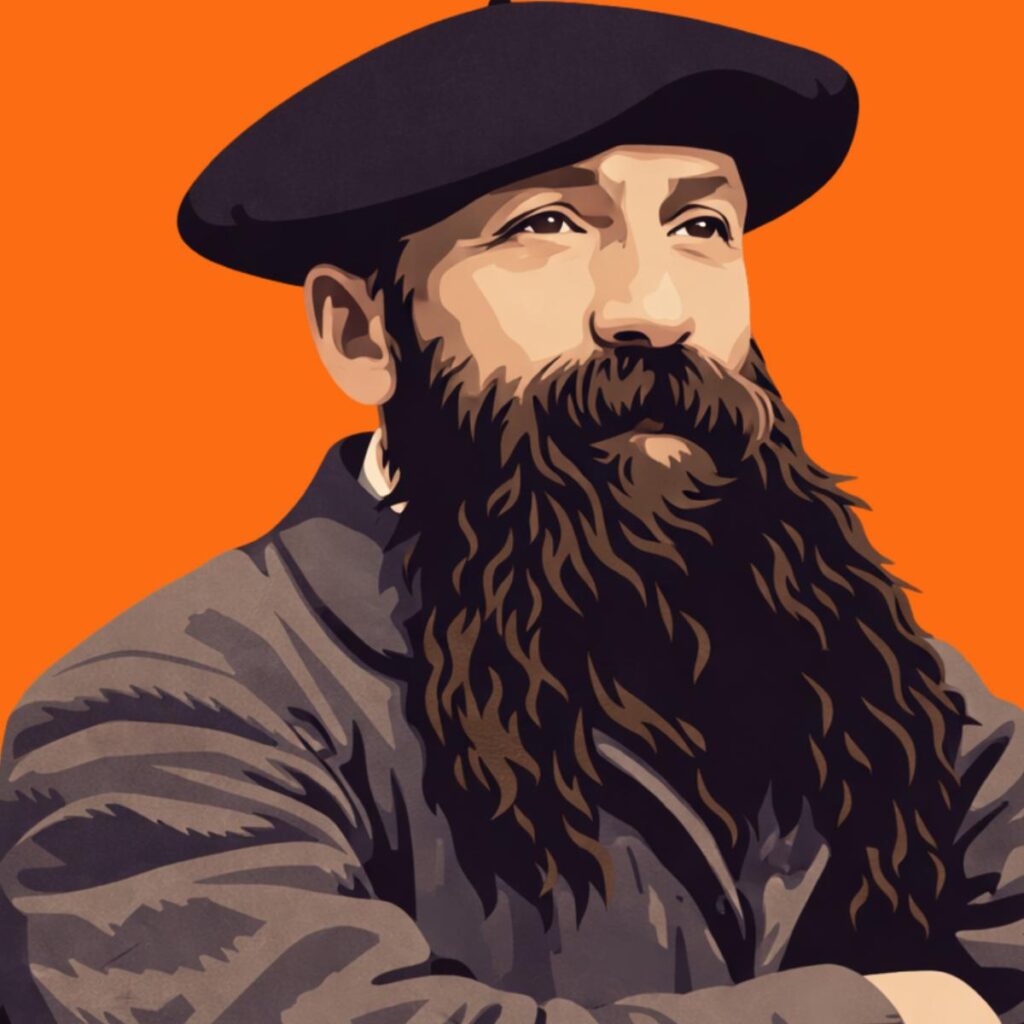
Did you know that some masterpieces are born from a silent struggle, between hands covered in dust and stone that refuses to yield? „Sculpture is the most difficult of the arts, because it demands a battle against matter” Rodin often said. Auguste was born in Paris in 1840 into a modest family. His father worked for the police, and his mother was a homemaker. Nothing, at first glance, seemed to destined him to become one of the greatest sculptors of all time. As a child, Auguste was not an outstanding student. He drew in the margins of his notebooks, daydreamed while watching the streets of Paris, and preferred shapes to words.
„I am not an academician, I am an artist,” he often declared.
He saw the world differently. Very early on, he understood that he wanted to create with his hands. Since he spent most of his time sketching drawings in his notebooks, his parents enrolled him at the age of fourteen in the Special School of Drawing and Mathematics in Paris.
His calling revealed itself when he stepped into a classroom where students were kneading clay. The following year, he discovered sculpture with Antoine-Louis Barye, and later with Albert-Ernest Carrier-Belleuse. He also regularly attended drawing classes at the Gobelins Manufactory, where he worked on the study of the nude.
“That’s where I truly began to understand the language of the body,” he later recalled.
But his dream went further. Several times, he attempted to enter the École des Beaux-Arts, yet he failed three times. The juries considered his work too rough, too alive, too far removed from academic rules.
- They reject me because I am different, Rodin murmured, disappointed.
Rodin suffered deeply from these rejections. Around him, others moved ahead more quickly, while he remained outside the gates. But Auguste did not give up.
To earn a living, he worked as a decorative craftsman. He sculpted for others, in the shadows, shaping ornaments, façades, and details that few people noticed. His hands learned patience, and his eyes learned the truth of the human body.
“Those obscure jobs were an extraordinary school. I learned to know the material, to feel its resistance, its possibilities…” he later confessed.
Then came the war of 1870. France was wounded. Rodin was too.
After returning, he traveled to Italy. There, he discovered Michelangelo — and it was a revelation. He realized that sculpture could express strength, pain, movement, the entire human soul.
- Michelangelo taught me to see beyond the surface, Rodin told his students.
From that day on, he decided to follow his own path.
He sculpted a nude man, bent forward, tense, vibrating with life. He called it The Age of Bronze. When the work was exhibited, scandal erupted. Rodin was accused of cheating, of having made a direct cast from a living model. No one believed a sculpture could appear so real.
- I copied nothing, he insisted. I observed.
- But how can one explain such striking truth, such perfect musculature? wondered an art critic of the time.
Rodin was hurt, but he stood firm. Little by little, the truth prevailed. Commissions began to arrive.
He was entrusted with a monumental work: The Gates of Hell. Rodin worked on it for decades, never considering it truly finished. From this doorway emerged famous figures such as The Thinker, The Kiss, and The Three Shades.
“This project is my testament; I will pour my whole life into it,” he often declared.
Rodin sculpted the way one writes an endless poem. He did not seek smooth perfection, but life itself. His bodies seemed to emerge from the material — unfinished, trembling, real.
- It is not beautiful, some said.
- Beauty is not what I seek. I seek expression, Rodin replied.
Among his students and collaborators was Camille Claudel. She was brilliant, passionate, and deeply connected to Rodin. Their relationship was made of creation and suffering, light and shadow. Rodin’s fame continued to grow, while Camille gradually faded into the background.
“He supports me, he understands me, he pushes me to surpass myself,” Camille confided to a friend.
But tensions rose, fueled by ambition and frustration.
Rodin suffered because of it. Yet he continued to work. He also became fascinated with representing movement and emotion, as seen in The Burghers of Calais in 1889, commissioned by the city to commemorate the siege of Calais during the Hundred Years’ War.
“We must give the impression that these men are leaving Calais, ready to die to save their city,” Rodin explained to those close to him.
By the end of his life, he was finally recognized. People came from all over the world to see his works. He lived surrounded by plaster, marble, and silence.
“Nothing is ever truly finished,” he would say.
Auguste Rodin died in 1917. But his sculptures remained. They still speak today. They tell of the weight of thought, the force of love, the weariness of the body, and the greatness of humankind.
“I sculpt life, not death,” he often said.
Rodin did not merely sculpt stone. He sculpted humanity itself.
And somewhere, in a studio, a young artist hesitates before a block of raw material. If they listen carefully, perhaps they too will hear — as Rodin once did — the form asking to be born.
“Let the stone speak to you,” he advised his young apprentices.