
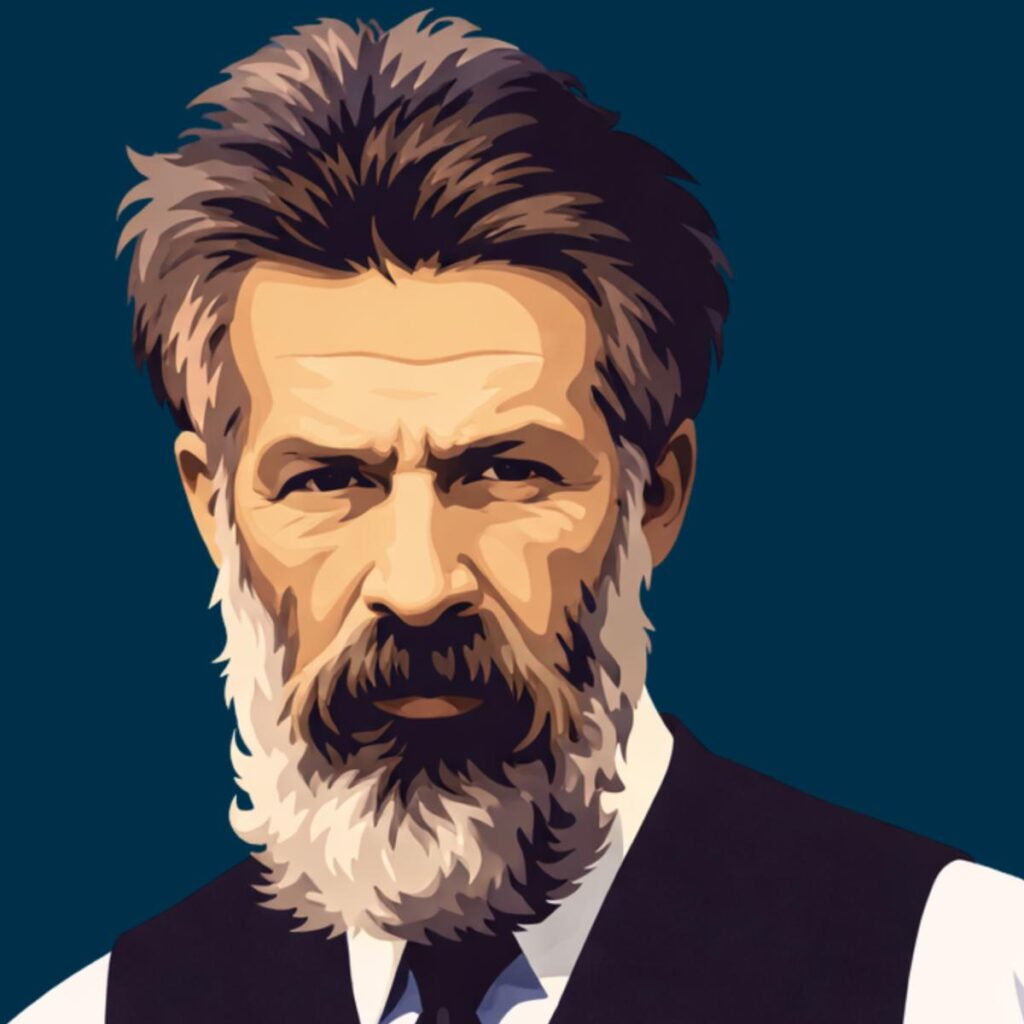
Did you know that even true stories begin with “once upon a time”? Constantin Brâncuși is one of the most renowned Romanian sculptors of the modern era and of contemporary art. The artist said that he was always inspired by simplicity, love of nature, and the common sense of the Romanian people, and these values can be found throughout his entire body of work.
Little Constantin, the fifth child of the Brâncuși family, was born on February 19, 1876, near Târgu-Jiu. Maria and Nicolae, his parents, used to send him to tend the sheep at a sheepfold, where he spent his time carving wood and listening to the shepherds’ stories. He learned to carve wood from an early age, from his grandfather and father, who made all kinds of objects needed around the household, but little Constantin was destined to turn craftsmanship into art. One day, when he was only seven years old, the boy set off on foot toward Târgu-Jiu, with the desire to discover the world beyond his village.
In order to earn money, Constantin worked as an apprentice for a canvas dyer and for a merchant who made him carry the customers’ heavy baskets. Seeing his talent, his employer, Ion Zamfirescu, helped him study at the School of Arts and Crafts in Craiova. After graduating, Brâncuși went to Bucharest to study Fine Arts.
— You are talented. Would you dare to sculpt the bust of General Carol Davila, the famous doctor who successfully reformed the medical system? Doctor Dimitrie Gerota asked him one day.
Although Constantin worked hard on this bust and skillfully modeled the plaster, the committee responsible for paying him decided that the bust was not successful enough. Sad and disappointed, Brâncuși then decided to leave the country, even without money. Thus, at only 27 years old, he set off alone on foot toward Paris, dreaming of studying art in depth and discovering the world.
The journey was difficult: the young man often slept under the open sky, sold his watch and clothes, washed dishes in restaurants, and endured hunger and cold in order to continue. But after one year, he arrived in France and enrolled in the School of Fine Arts.
In 1907, Constantin was accepted as an apprentice in the workshop of Auguste Rodin, a very famous French sculptor of that time, often compared to Michelangelo.
— Stay and work with me! Rodin proposed after only one month.
— Master, nothing grows in the shadow of great trees! Brâncuși replied proudly, leaving the workshop forever. I want to find my own path!
Thus, between 1907 and 1910, Constantin Brâncuși created three major works of his youth: Prayer (Rugăciune), The Kiss (Sărutul), and The Wisdom of the Earth (Cumințenia Pământului). Many of his later creations were inspired by real people. In addition to all the faces sculpted by Brâncuși, the artist also created other astonishing “pure forms” that express emotions such as dynamism, spirituality, and sensitivity, in plaster, marble, bronze, and wood. In The Kiss, he used the technique of direct carving, and this sculpture is considered the first modern sculpture of the 20th century.
However, very few of Brâncuși’s works are still found in Romania; most of them can be admired in the greatest museums and collections in the world. For this reason, we can say without a doubt that Târgu-Jiu is a unique city in the world. Here lies the monumental ensemble The Way of the Heroes, created between 1937 and 1938. Almost all couples who arrive in the central park embrace and kiss as they pass beneath the Gate of the Kiss, then continue toward the Avenue of the Chairs, along which there are thirty stone seats that people have associated with many symbols, such as the months of the calendar or moments of reflection on life and even death. In Târgu-Jiu there are also the Table of Silence and the Endless Column, which are also part of the sculptural ensemble known to all Romanians. It was conceived as a tribute to the heroes who fell during the First World War.
After completing this ensemble, Constantin Brâncuși left Romania and headed once again for France. During that period, the Second World War also began, a time when Romania was under a very complicated and restrictive political regime that did not encourage modern art or creativity. Although the sculptor wished to offer the works he had created to the Romanian state, the communists refused them, so the artist left his studio and creations as a legacy to the French state. Today, his Paris studio has been turned into a museum and can be visited.
After the great Brâncuși, more than 200 sculptures and drawings and over 1,500 photographic plates remain. During his lifetime, his works were loved but also criticized. He took part in countless exhibitions in Romania, Paris, London, New York, Amsterdam, and Venice, and was visited by collectors from all over the world. He stopped sculpting in the early 1950s and passed away on March 16, 1957, at the age of 81.