
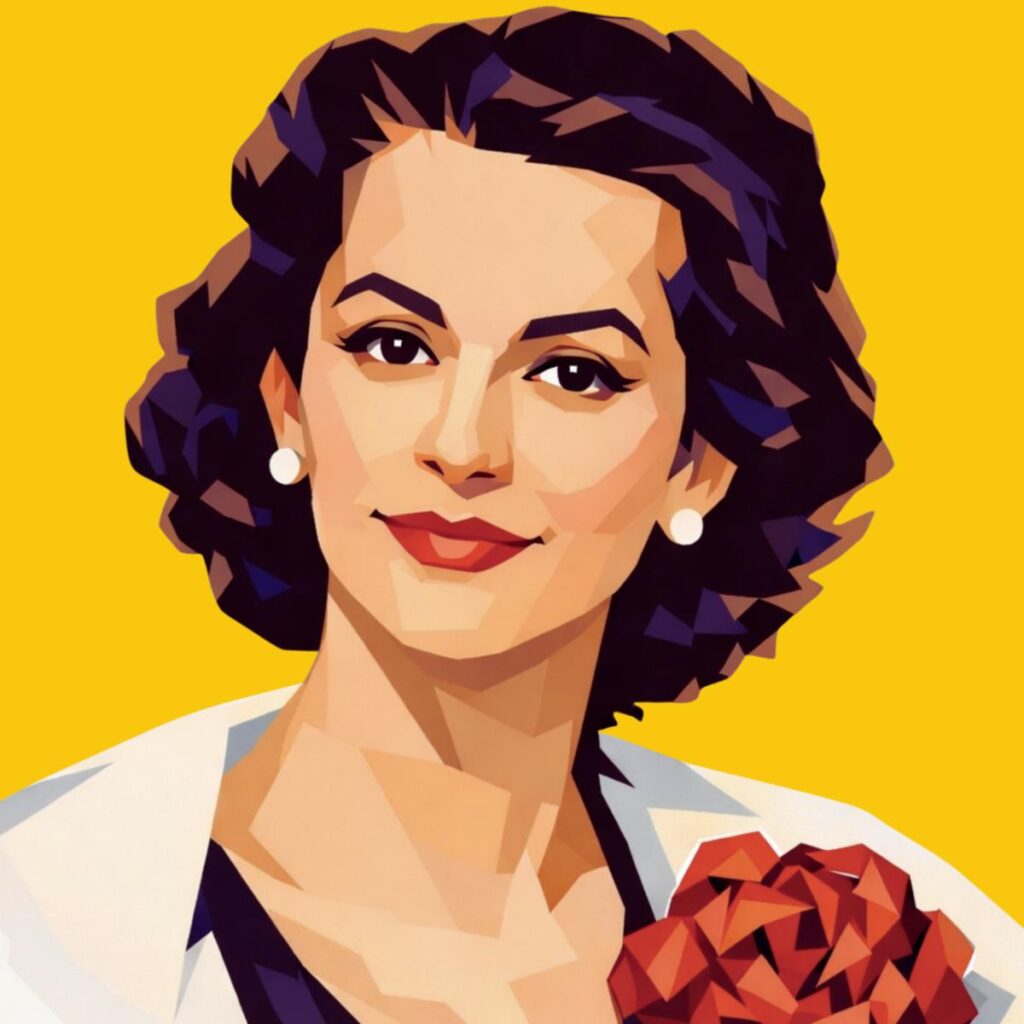
Did you know that even true stories begin with… once upon a time? Researcher Ana Aslan discovered what youth truly means: to be optimistic, to feel comfortable in your own skin, and to have an ideal worth fighting for.
Ana was born on the first morning of the year 1897, in Brăila. Her father, Mărgărit, looked at her with a special tenderness. He was 59 years old when Ana was born and would often say proudly:
— She is proof of my late youth.
The peace of that childhood did not last long. The family’s fortune diminished considerably because of poorly inspired investments. When Ana was only thirteen years old, her father passed away.
Then, in the pain of loss, the determination that would define her was born: the fight against time. From that moment on, the dreamy child began to turn into the woman who would change medicine.
Her mother decided to move with all the children to Bucharest, in order to offer them a better future. Ana’s distinctive nature—always curious and determined—naturally led her toward medicine. In the 12th grade, with her first anatomy lessons, Ana felt she had found her path: the mysteries of the human body fascinated her instantly. Her mother, however, was not pleased at all. Influenced by the prejudices of the time, she believed that the medical profession was not one “for women.”
— It’s too hard, too harsh… she tried to convince her.
Ana did not give in. More than that, she resorted to an extreme gesture: a hunger strike lasting three days.
— If you don’t eat, that doesn’t mean you’ll become a doctor, her worried mother said.
A true “family council” followed: siblings, cousins, and close relatives—many of them university professors and intellectuals—gathered to convince her mother. Her brothers took Ana’s side. Thus, on October 13, 1915, Ana Aslan was admitted to the Faculty of Medicine. She would later say with a smile: “For me, the number 13 brings good luck.”
When the First World War broke out, the young woman was a third-year medical student. This is how she ended up in hospitals behind the front lines in Iași. The wards were full, and doctors worked to exhaustion. Day after day, dressed in her white coat among the patients, she assisted in difficult surgeries and learned what responsibility truly meant.
Returning to Bucharest in 1919, Ana began working alongside Gheorghe Marinescu, a very well-known physician. She became a teaching assistant at Clinic II in Bucharest, led by Daniel Danielopolu, a professor from whom she learned the value of organization. At just 27 years old, she earned her doctorate.
Ana Aslan began to view aging differently from the medical world of her time: what if old age did not merely have to be endured, but could be delayed? she wondered. In the early 1950s, working alongside Professor C. I. Parhon, she began studying the effects of procaine, a substance known until then mainly as an anesthetic. The first result came unexpectedly. A young student, bedridden due to a completely blocked knee, no longer responded to any treatment. Ana asked for permission to try something new. After administering procaine, a miracle occurred: the young man was able to move his knee. After a few days, he left the hospital on his own feet. “I went crazy with joy,” Ana would later confess. “And so did he.”
In 1952, she took an even greater step: she founded the world’s first Institute of Geriatrics, recommended as an organizational model by the World Health Organization. Ana Aslan’s belief was simple and profound: “The real challenge is to add life to years, not just years to life.”
A world premiere followed: the first medication created specifically to delay the aging process—Gerovital H3. In 1957, this miraculous drug was approved in over 30 countries and became known on all continents.
Thanks to her activity, Ana Aslan became a member of the Romanian Academy. She received the “Leon Bernard” Prize and Medal from the World Health Organization, as well as distinctions from Italy, France, Czechoslovakia, and India. She was named Professor Honoris Causa and Doctor Emeritus in Brazil and became a member of the New York Academy of Sciences.
In the 1970s, Romania was known as a country of medical tourism. Ten percent of foreign visitors came for Ana Aslan’s treatments, and her work generated revenues of over 17 million dollars annually. She was sought after by everyone—from crowned heads to ordinary patients. Personalities such as Charles de Gaulle, Indira Gandhi, Tito, Charlie Chaplin, Salvador Dalí, Marlene Dietrich, Nikita Khrushchev, Claudia Cardinale, John F. Kennedy, as well as kings of Saudi Arabia and Morocco, famous writers, and extremely wealthy businesspeople all came to the Institute of Geriatrics. Everyone came to Bucharest in search of the “secret of youth.”
Yet, when she sat beside a patient, Doctor Aslan forgot about fame and schedules. Proof lies in the thousands of letters she received throughout her life—over 130,000 messages of gratitude and kind thoughts. Her fame was so great that sometimes the envelope bore only these words: “Ana Aslan, Romania”, and the letter would reach its destination without fail.
Outside the laboratory, Ana Aslan was a very elegant and refined woman. She loved books, Chopin’s music, followed gymnastics competitions, and went to the cinema. She enjoyed elegance, ordered her clothes from Italy, and wore beautiful jewelry. She did not start a family, as life and her profession did not allow her that respite.
Her success attracted the envy of the communist authorities. In the early 1980s, a trial was initiated against her, accusing her of not charging elderly patients at the Institute, thus depriving the State of significant revenues. After seven years of trials, just a few months before her death, she was declared innocent. She passed away at the age of 91.
Ana Aslan proved that age is not a limit, but a stage of life that can be lived beautifully. Through everything she did, she left behind not only scientific discoveries, but also a simple and powerful lesson: life can be lived with dignity and hope at any age. “I regret nothing. Time is only a measure. What matters is what you do with it.”